Research
I explore the fundamental principles of networked system dynamics by integrating machine learning, network science, and dynamical systems theory. The work spans theoretical innovation and practical application, and centers on efficient, interpretable models that improve decision-making in real-world contexts.
Why networks matter
COVID-19 has caused over 6 million deaths worldwide since late 2019 and an estimated $12.5 trillion in economic loss as of 2024. The pandemic exposed deep vulnerabilities in modern networked systems: disrupted supply chains, financial market volatility, misinformation amplified across social networks. The July 2024 CrowdStrike update failure brought airlines, hospitals, and businesses to a standstill worldwide, underscoring how far cascading effects travel inside interconnected systems. Climate change, pandemics, and food security all run on interdependent networks (transportation, finance, supply chains, ecology, social networks) that form the backbone of our societal and economic infrastructure. As the world grows more interconnected, resilient and interpretable network models become essential.
Research interests
The first interest is the long-standing core. Language models and music are newer and growing. Uncertainty and spectral analysis are tools used across all of them, and physical dynamics is the newest.
Network science, graph machine learning and dynamical systems
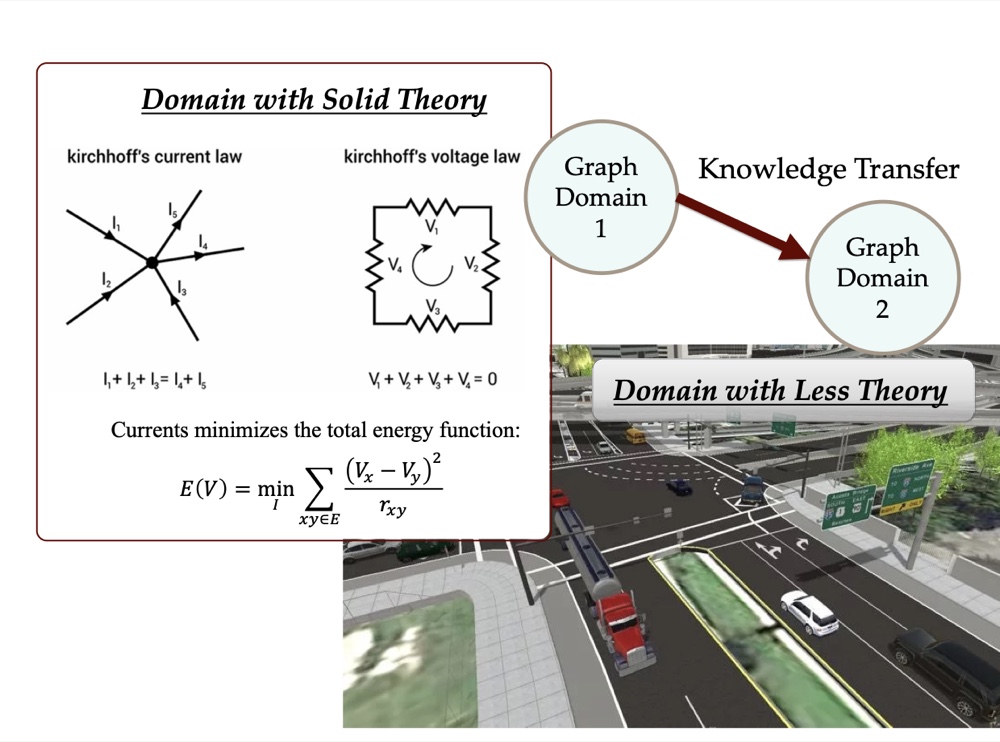
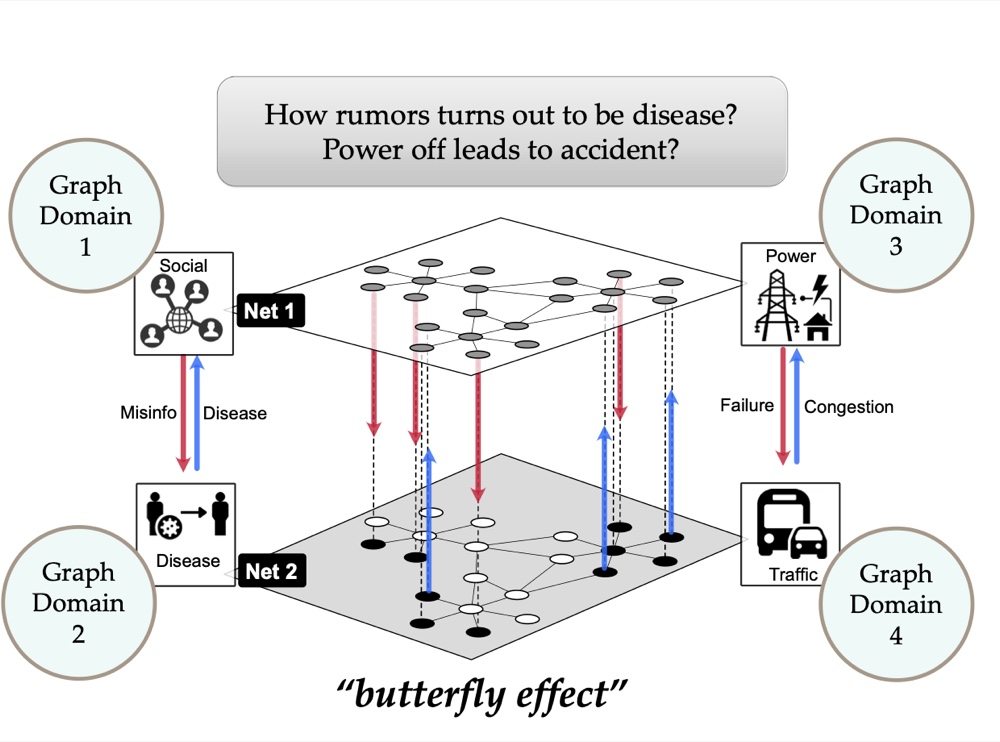
Roads, power grids, epidemics and social media are all networks, and what happens on one network often spreads into another. I study how behavior spreads, settles and breaks in connected systems, and how to estimate and control it.
I look for generalized patterns that hold across very different networks, and for cross-system behaviors that pass from one network to another. The tools are spectral and functional analysis and uncertainty quantification. The systems studied include traffic grids, power networks, epidemics, social networks, banking and supply chains.
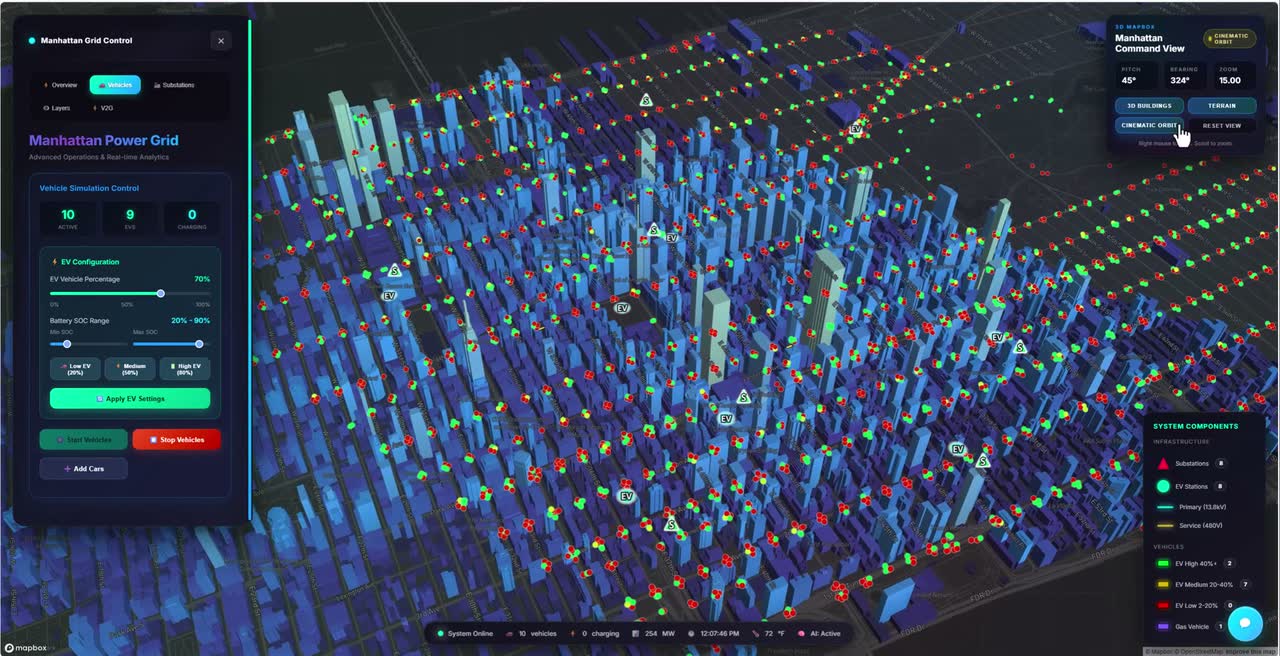
One example is a real-time Manhattan power and traffic co-simulation, in which electric vehicle charging load is fed back into the grid. Relevant support: NSF CAREER #2443266 and NSF CIRC #2345921, both listed under Grants below.
Selected work
- Network interdiction goes neural KDD, 2025
- Sumo x PyPSA: Interactive web demo of real-time urban power-traffic co-simulation with vehicle-to-grid WWW Companion, 2026
- Graph symbolic regression for animal disease propagation SIGSPATIAL, 2025
- LLM-to-Map, demo IJCAI, 2026
Mechanistic understanding of large language models
Language models are changed after release. Facts are edited, layers are merged, weights are pruned or compressed. A model can pass the usual output tests after such a change while something inside it has broken.
I read a trained model's activations as a graph and compare that graph before and after a change. Delta-Graph Signatures (SDM 2026, accepted) uses this comparison to flag knowledge edits that pass standard checks but damage unrelated knowledge. A separate CIKM 2026 paper gives a formal pre-condition for checking whether a knowledge graph structurally supports a query before a language model generates from it.
Next steps are steering, model stitching, and detecting silent degradation from other model changes: fine-tuning, merging, quantization, pruning and distillation. The colloquium "From Networks to Neural Networks" gives a tutorial-style overview of this line.
Selected work
- Delta-graph signatures for post-edit risk screening in knowledge editing SDM, 2026
- Query-graph compatibility: A formal pre-condition for faithful knowledge-grounded language model generation CIKM, 2026, with Mariam ALMutairi and others
- Is There a Graph Inside Generative Models? Evidence from Language and Music RIT CS Department Colloquium, Nov 2026, and GCCIS PhD Colloquium, Oct 2026, slides
Computational musicology
Music generation models now produce convincing audio, yet little is known about how they represent style. My first music paper fused two genres into a new one with adversarial dual learning (ICDM 2017, with Alexander Lerch).
Music is now a main and growing line of my work. The questions are how generation models encode style, how far that style can be steered, and how this can serve music for health and hearing. EEG and wearable sensors are being considered for the health side.
Selected work
- Learning to fuse music genres with generative adversarial dual learning ICDM, 2017, with Alexander Lerch
- Fusion-GAN, code for the ICDM 2017 paper GitHub
Uncertainty quantification
A prediction on a network is only useful if we know how far to trust it. Data are usually sparse, such as a few road sensors or one snapshot of an outbreak, and the network itself may be uncertain.
I build methods that say how sure a prediction is and that make good decisions anyway. Kalman filtering paired with graph convolution forecasts traffic with error bars. Graph Bayesian optimization finds where a spread started from a single snapshot, and picks the best seed users across several linked networks. Sobol and Shapley analysis separate a node's own effect from its interactions with others.
Selected work
- Uncertainty Quantification for Dynamical Networks, tutorial WSDM 2026 and IEEE BigData 2026
- Multiple-source localization from a single-snapshot observation using graph Bayesian optimization AAAI, 2024
- Graph Bayesian optimization for multiplex influence maximization AAAI, 2024
- Sobol's total indices for accurate and scalable feature exclusion in high-dimensional data IEEE BigData, 2025
- Understanding influence maximization via higher-order decomposition SDM, 2023
- Graph convolutional networks with Kalman filtering for traffic prediction SIGSPATIAL, 2020
Spectral analysis, mainly on graphs
A graph's eigenvectors play the role that sine waves play for sound. They split a signal on a network into smooth and fast-changing parts, which makes filtering, comparison and theory possible.
I use this view to unify graph neural networks: spectral and spatial models turn out to be two readings of the same operator, and rational approximations give sharper graph filters. Recent work applies spectral analysis mainly to graphs, from infrastructure networks to graphs read out of model activations.
Selected work
- Bridging the gap between spatial and spectral domains: A unified framework for graph neural networks ACM Computing Surveys, 2023
- Rational neural networks for approximating graph convolution operator on jump discontinuities ICDM, 2018
- Unifying Spectral and Spatial Graph Neural Networks, tutorial series CVPR 2024, CIKM 2024, SIAM MDS 2024, SIAM SDM 2025
- Awesome Spectral GNN, paper collection GitHub
Dynamical systems in physics
Many physical systems follow the same kind of law: a state that changes over time under local rules. I am interested in three of them. Fluid dynamics describes how air and water move. Power system dynamics describes how a grid's frequency and voltage swing after a fault. Molecular dynamics describes how atoms in a material or a protein move.
This is an exploratory interest with no published work yet. The pull is that the tools from my network work, such as graph models, spectral analysis and uncertainty estimates, fit these systems naturally.
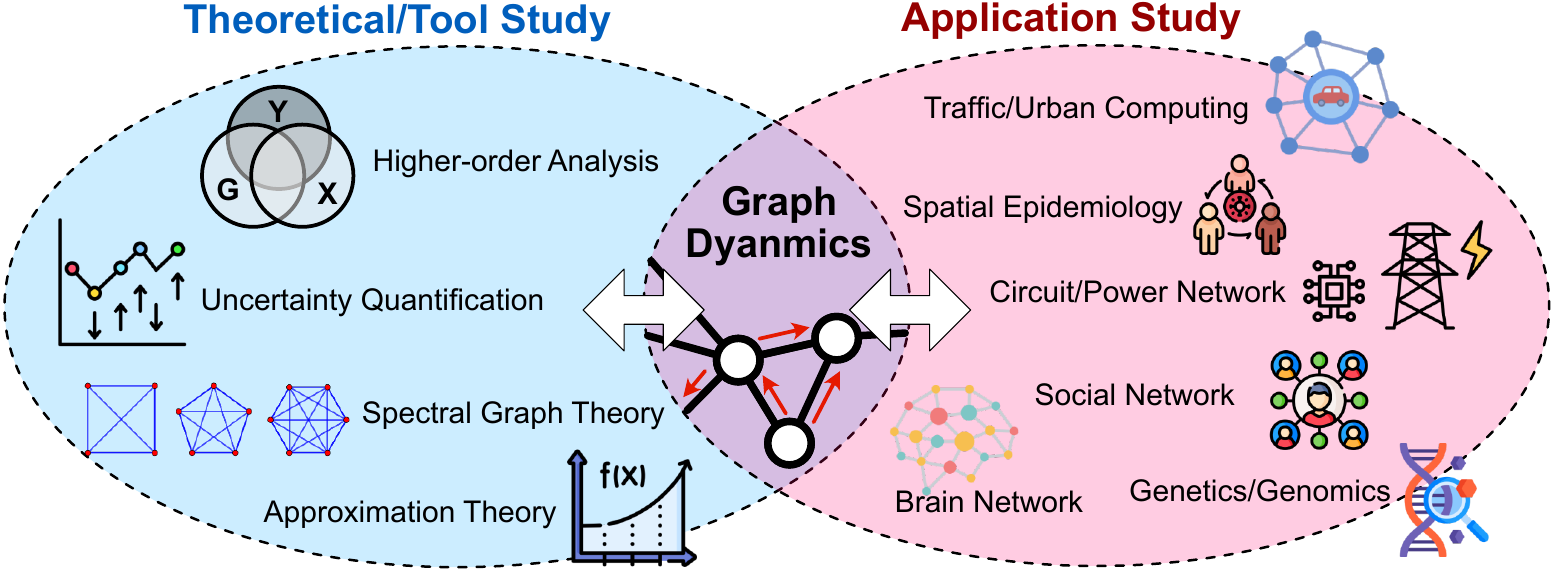
Overview diagram: the tools and the systems they are applied to
Grants
Research grants first, then smaller awards and compute credits. Rows with a link open the award record.
Research grants
Smaller awards and compute
Internal support at Mississippi State (4)
Honors
- 2026 Top Area ChairNeurIPS 2026Service
- 2025 Research FellowSocial Science Research Center, Mississippi State UniversityResearch
- 2025 Ottilie Schillig Special Teaching AwardCenter for Teaching and Learning, Mississippi State UniversityTeaching AI teaching gamification with the Lego Education kit.Award recipients
- 2025 Excellent Reviewer (top 20%)ACM SIGKDD 2025Service
- 2024 Excellent ReviewerIEEE Transactions on Network Science and EngineeringService
- 2021 Editor's Choice ArticleSensors (MDPI), 2021Research Review of convolutional neural network vision systems in animal farming.The article
- 2020 Best Paper AwardACM SIGSPATIAL 2020Research Domain knowledge in memetic algorithms for spatial optimization.Award recipients
- 2019 Top 50 Chemistry and Materials Sciences ArticlesNature Communications, 2019ResearchThe article
- 2016 Outstanding Contribution AwardToyota Research Institute, North AmericaIndustry
- 2015 Best Paper AwardGISTAM 2015ResearchAward recipients
Service
- Co-Chair
- Panelist NSF review panels, 2021, 2023, 2024
- Area Chair ICML 2027, NeurIPS 2026
- Reviewer ICML, ICLR, NeurIPS, AAAI, IJCAI, KDD, SIGIR, IEEE TKDE, ACM TKDD, ACM Computing Surveys, etc.
- Editorial Board Frontiers in Big Data (Data Science, and Data Mining and Management), Topic Editor, 2022 to present