
Turing AI Gift Money
Gift support for LLM-related research.
COVID-19 has caused over 6 million deaths worldwide since late 2019 and an estimated $12.5 trillion in economic loss as of 2024. The pandemic exposed deep vulnerabilities in modern networked systems — disrupted supply chains, financial market volatility, misinformation amplified across social networks. The July 2024 CrowdStrike update failure brought airlines, hospitals, and businesses to a standstill worldwide, underscoring how far cascading effects travel inside interconnected systems. Climate change, pandemics, and food security all run on interdependent networks — transportation, finance, supply chains, ecology, social networks — that form the backbone of our societal and economic infrastructure. As the world grows more interconnected, resilient and interpretable network models become essential.
Research interest. I explore the fundamental principles of networked system dynamics by integrating machine learning, network science, and dynamical systems theory. The work spans theoretical innovation and practical application, and centers on efficient, interpretable models that improve decision-making in real-world contexts.
I study graph dynamics through spectral graph theory, uncertainty quantification, higher-order analysis, and physics-inspired methods. My current focus is the behavior of coupled and interdependent networks — prevalent in practice, but still thinly developed.
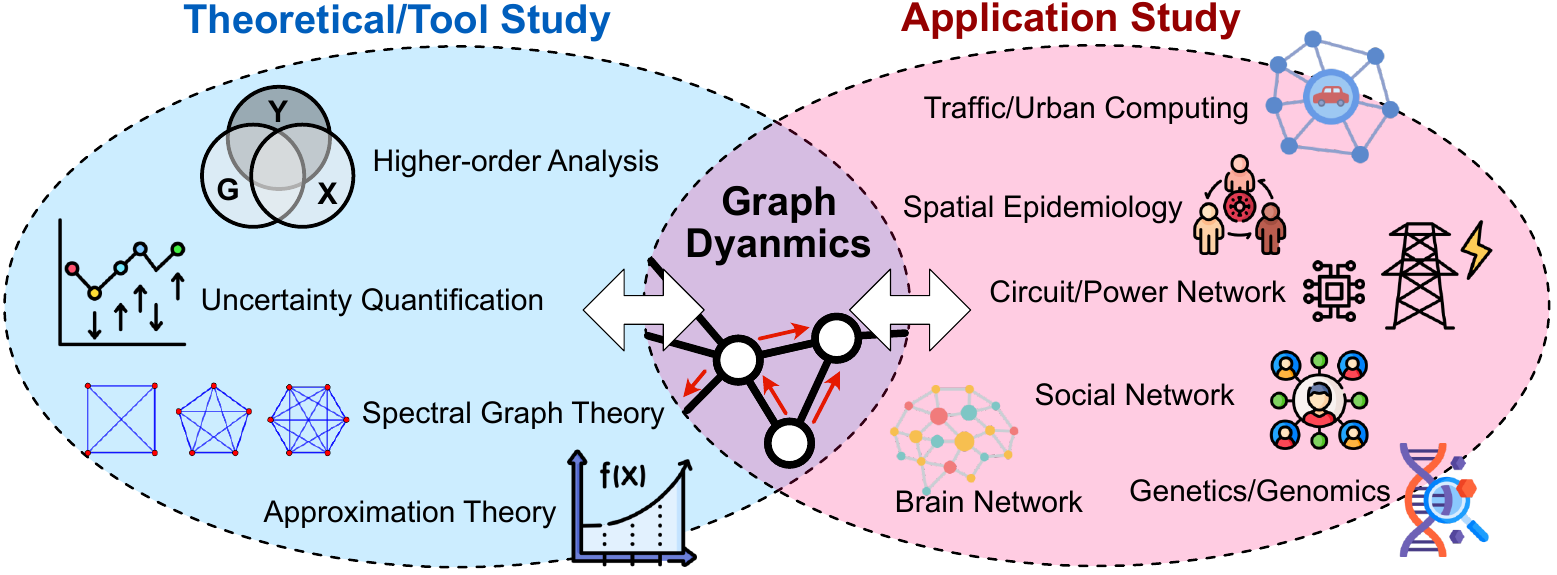
Theoretical study. Developing new methodology to represent and analyze graphs and their dynamics. I have explored spectral graph theory as a unified framework for representing complex networks — several papers, a survey, tutorials at prestigious venues, and a widely used paper collection. I also investigate higher-order methods such as Shapley values and Sobol indices to understand combinatorial interactions among nodes, and use Bayesian optimization, Gaussian processes, and Kalman filtering to address efficiency in graph-based problems.
Application research. The work reaches key social infrastructure and biological networks: transportation and urban systems, spatial epidemiology, and genetic networks. Collaborations with ecologists, medical researchers, and engineers have extended these methods to ecological networks, circuit dynamics, and brain signals in conditions such as ADHD and sleep disorders.

CAREER project on unification and interactions across graph dynamics in interdependent networks.
Speech detection using LLMs and graph neural networks.
Planning-C project on graph flow analytics and integrated infrastructure.
CRII project on interpretable influence propagation and blocking on graphs.
AI education and pathway-building program for diverse high school students (with supplemental award).
Gift support for LLM-related research.

Detection and modeling tools for animal disease epidemiology.
Agricultural research enabled by HPC infrastructure and collaboration.
Supplementary undergraduate research support.
Summer internship support connected to USDA research activity.

Cloud compute credits for research.

CRA-sponsored undergraduate research experience.

NAIRR pilot allocation for GPU-based research.

Internal teaching award support through the Center for Teaching and Learning.
Internal seed grant support through the International Institute.
Internal support from Bagley College of Engineering.
Office of Research and Economic Development undergraduate research support.